
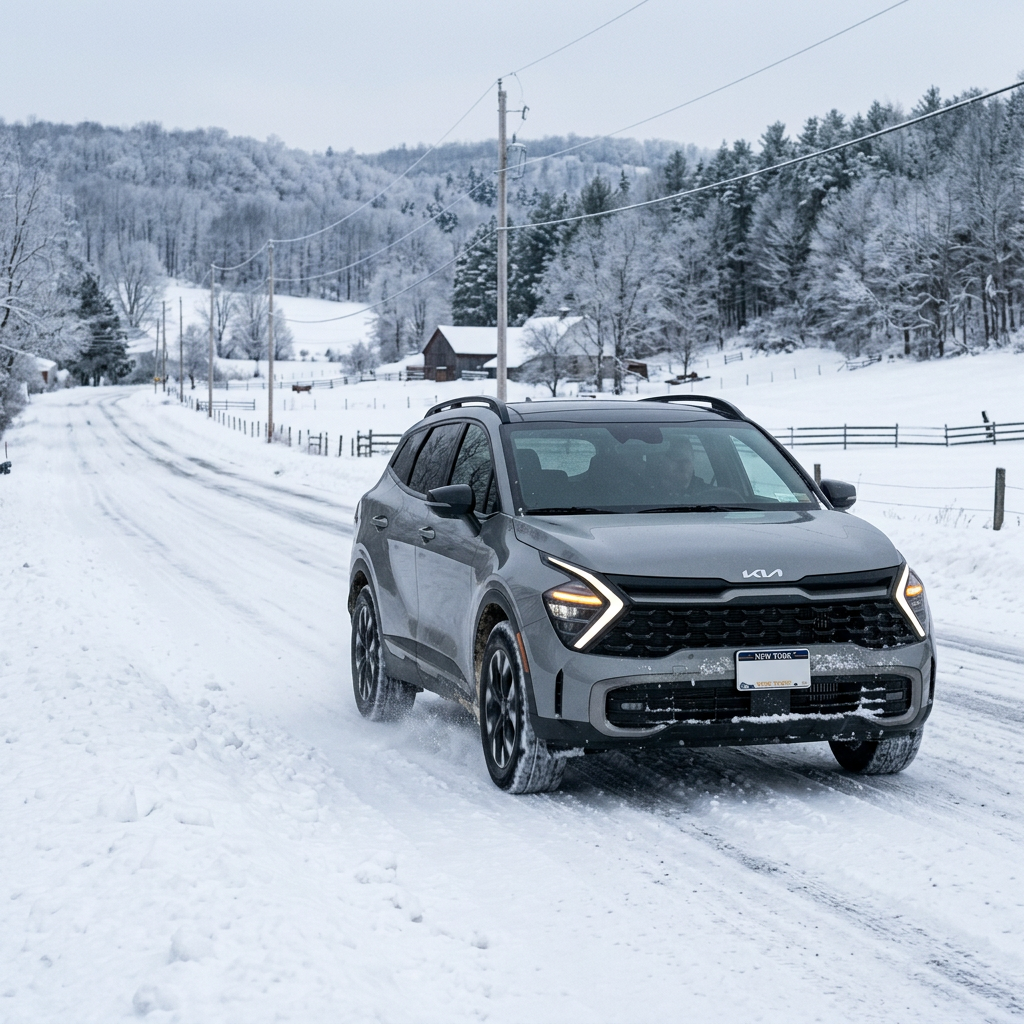
Kia vehicles excel in deep winter snow through a combination of proactive All-Wheel Drive, up to 9.1 inches of ground clearance, specialized driver-selectable Snow Mode, and cold-weather thermal management features like available heated washer nozzles and remote climate preconditioning. Rather than reacting after tires slip, these coordinated systems predict surface traction, adjust engine torque delivery, and maximize mechanical grip to keep vehicles moving through heavy drifts and packed road ice.
When heavy winter storms deposit thick accumulation across the regional road network, standard front-wheel drive hatchbacks and light-duty sedans often struggle to break through packed snowbanks or climb slick grades. Kia engineers its utility vehicle lineup specifically to counter these northern road conditions. Models like the 2026 Kia Sportage and 2026 Kia Sorento combine electro-hydraulic drive couplings with sophisticated electronic control units. These systems continuously monitor wheel speed, steering angle, outside temperature, and throttle input. By actively transferring power to the axle with the most grip before wheel spin starts, the drivetrain prevents loss of momentum when pulling out of unplowed driveways or navigating slushy highway lanes.
For drivers navigating the valley roads and rolling hills around Olean during peak lake-effect weather, vehicle architecture plays as vital a role as electronic traction control. High ground clearance prevents the underbody from acting like a plow in deep snow, while standard safety systems—including Forward Collision-Avoidance Assist, Lane Keeping Assist, and Electronic Stability Control—work alongside the drivetrain to stabilize the vehicle during emergency maneuvers on low-friction surfaces.
To explore our current winter-ready inventory or ask our team about specific trim capabilities, visit our showroom on East State Street or give our sales specialists a call at (716) 372-0080.
Table of Contents
- How Does Kia All-Wheel Drive with Snow Mode Perform on Slick Roads?
- What Ground Clearance Do Kia SUVs Offer for Deep Lake-Effect Snow in Cattaraugus County?
- Are All-Weather Tires Sufficient for Winters Compared to Snow Tires?
- What Winter Convenience Features and Remote Start Options Does Kia Offer?
- What Essential Maintenance Inspections Prepare Your Kia for Winter?
- Key Winter Driving Questions Answered
- Schedule Your Winter Preparation Service at Paul Brown Kia
How Does Kia All-Wheel Drive with Snow Mode Perform on Slick Roads?
Kia All-Wheel Drive with Snow Mode improves slick-road control by using multi-sensor predictive monitoring to split engine torque between the front and rear axles while softening throttle response to stop tires from spinning. Standard reactive all-wheel drive systems wait until the front wheels lose traction before directing torque rearward, which frequently breaks tire adhesion on ice. Kia's All-Wheel Drive uses an electro-hydraulic coupling that adjusts torque to the rear wheels based on throttle position, steering angle, and wheel speed, helping establish traction before slip occurs.
Selecting Snow Mode via the drive mode control dial changes how the vehicle's engine, transmission, and braking systems behave:
- Softened Throttle Calibration: Linearizes accelerator pedal sensitivity so sudden driver inputs do not send a burst of power to the wheels, allowing controlled, gradual launches on sheet ice.
- Transmission Shift Logic: Holds higher gear ratios early and upshifts sooner to limit engine torque output at low speeds, preventing wheel spin when accelerating from a stop.
- Proactive Rear Torque Bias: Automatically pre-allocates power to the rear axle when starting from a complete standstill on sub-freezing surfaces.
- Traction Control Re-Calibration: Modifies the Traction Control System intervention threshold, permitting just enough controlled wheel rotation to clean out tread packed with wet slush while preventing runaway rotation.
For extreme low-speed situations—such as freeing a vehicle from a deep snowbank or crawling up an icy grade under 25 mph—many Kia models feature an AWD Lock button. Engaging this feature manually locks the electro-hydraulic coupling into a fixed 50/50 front-to-rear torque split. This equal force distribution ensures all four wheels push simultaneously, giving drivers maximum low-speed extraction power when road conditions are at their worst.
What Ground Clearance Do Kia SUVs Offer for Deep Lake-Effect Snow in Cattaraugus County?
Kia SUVs offer ground clearance measurements ranging from 6.9 inches on front-wheel-drive models up to 9.1 inches on the 2027 Telluride X-Pro, with all-wheel-drive Sportage and Sorento models at 8.2 inches or more. Higher ride height prevents the vehicle's frame and bumper covers from dragging across packed snow drifts, keeping the tires firmly planted on the road surface underneath.
When lake-effect snow bands sweep across the region, unplowed back roads and plow ridges at the end of driveways present immediate high-centering hazards. If a crossover with low ground clearance attempts to drive through 6 to 8 inches of dense, wet snow, the underbody engine shield and floor pans compress the snow underneath. This lifts weight off the tires, causing loss of traction regardless of how advanced the all-wheel drive system is.
| Kia SUV Model | Standard Ground Clearance | Trim/Package Max |
|---|---|---|
| 2026 Kia Sportage | 7.1 in (FWD) / 8.3 in (AWD) | 8.3 in (all AWD trims, incl. X-Pro) |
| 2026 Kia Sorento | 6.9 in (FWD) / 8.2 in (AWD) | 8.2 in (all AWD trims, incl. X-Line & X-Pro) |
| 2027 Kia Telluride | 7.4 inches | Up to 9.1 in (X-Pro) |
All-wheel-drive 2026 Kia Sorento models, including the X-Line and X-Pro configurations, feature 8.2 inches of ground clearance paired with elevated approach and departure angles, allowing the front fascia to clear steep snowbanks without cracking delicate plastic trim. Similarly, every all-wheel-drive 2026 Kia Sportage offers 8.3 inches of clearance, and the X-Pro trim adds high-profile all-terrain tires. This extra height creates essential space for snow and slush to pass beneath the chassis without interfering with steering linkages or exhaust components.
Are All-Weather Tires Sufficient for Winters Compared to Snow Tires?
All-weather tires carrying the 3-Peak Mountain Snowflake (3PMSF) rating provide adequate safety in light to moderate snow, but dedicated winter tires deliver superior braking distances and cornering grip when driving through severe lake-effect slush and black ice. Understanding the rubber chemistry and tread design differences helps drivers determine which tire option matches their daily route requirements.
All-weather tires represent an evolution beyond traditional all-season tires. While standard all-season rubber hardens and loses flexibility when temperatures drop below 45°F, all-weather tires use advanced silica compound blends that remain pliable in sub-freezing weather. They feature aggressive tread patterns with denser siping, allowing them to earn the 3-Peak Mountain Snowflake symbol. Because they can be driven year-round without rapid tread wear in summer, all-weather tires eliminate the need for seasonal tire swaps and second-wheel storage.
Dedicated winter tires are engineered exclusively for cold, low-friction conditions. Their compound contains specialized soft polymers and hydrophilic rubber that remains soft down to deep sub-zero temperatures. Features unique to dedicated snow tires include:
- Micro-Porous Compound Traction: Absorbs the thin surface layer of water created by friction on ice, allowing the tread block to make direct contact with the frozen road.
- High-Density 3D Zig-Zag Sipes: Thousands of tiny slits in the tread blocks open up under rotational stress, creating thousands of sharp biting edges that grip packed snow.
- Self-Cleaning Tread Grooves: Wide directional channels pump heavy slush out to the sides of the tire, keeping the center tread clean for continuous contact.
When evaluating daily driving needs across the Olean area, all-weather tires suit drivers who travel primarily on main corridors cleared promptly by municipal road crews. However, for those who commute early in the morning before snowplows run or travel steep, unplowed rural hills, dedicated winter tires mounted on a second set of wheels offer the highest level of stopping power and lateral stability.
What Winter Convenience Features and Remote Start Options Does Kia Offer?
Kia offers a comprehensive suite of winter convenience technologies centered around the Kia Access smartphone application, Kia Connect telematics, and cabin comfort hardware. Through Kia Connect, drivers can remotely start their engine and precondition the interior temperature from their phone, ensuring defrosted glass and a comfortable cabin before stepping outside.
| Winter Feature | Primary Operational Benefit |
|---|---|
| Remote Start w/ Climate Control | Heats cabin, defrosts glass, and warms seats |
| Heated Steering Wheel | Warms hands quickly without heavy winter gloves |
| Heated Windshield Wiper De-Icer | Melts ice packed at base of windshield wiper blades |
| Heated Washer Nozzles | Prevents washer fluid sprayers from freezing shut |
| Heated Front & Rear Seats | Provides direct radiant heat to occupants |
Remote climate preconditioning allows users to set desired cabin temperatures, activate the heated steering wheel, turn on heated seats, and engage the front and rear window defrosters. On gasoline vehicles, this feature runs the engine for up to 10 minutes to bring coolant up to operating temperature. On electric models like the EV6, remote preconditioning draws energy directly from the charging grid when plugged in, preserving battery driving range while warming the high-voltage battery pack for optimal energy efficiency.
Kia's automated exterior winter safeguards also protect critical visibility components:
- Automated Heated Washer Nozzles (select trims): Activate automatically when ambient temperatures drop below 41°F and turn off once temperatures rise above 50°F. To prevent battery drain, the system includes an automatic 20-minute shutoff timer when operated with the ignition on.
- Windshield Wiper De-Icer: Heating elements embedded in the lower glass melt accumulated ice under the wiper blades, preventing torn rubber blades and streaked glass.
- Heated Outside Mirrors: Linked to the rear glass defroster button, heated side mirrors clear fog, frost, and ice sheets in minutes.
What Essential Maintenance Inspections Prepare Your Kia for Winter?
Essential winter maintenance requires checking 12-volt battery health, inspecting brake pad thickness and rotor condition, verifying tire tread depth, and testing coolant freeze-point protection before sub-freezing temperatures arrive. Proactive seasonal service prevents mechanical breakdowns during harsh northern weather.
Cold weather reduces a 12-volt car battery's cranking capacity by up to 50 percent while simultaneously increasing the mechanical resistance of cold engine oil. A battery that performs adequately in summer can fail on the first sub-zero morning. Certified technicians perform a conductance test to measure cold cranking amps against factory specifications, catching weak cells before they leave drivers stranded.
| Inspection Item | Recommended Winter Maintenance Standard |
|---|---|
| 12-Volt Battery | Conductance test; clean terminals & verify CCA |
| Brake System | Inspect pads, rotors, caliper slide pins & fluid |
| Engine Coolant / Antifreeze | Refractometer test freeze protection to -34°F |
| Windshield Wipers & Washer Fluid | Install winter wiper blades & -20°F rated fluid |
| Tire Tread Depth & Pressure | Minimum 5/32" tread depth; adjust for cold drop |
Before severe weather arrives in Olean, winterizing a vehicle involves several critical service steps:
- Brake System Inspection: Road salt causes rust buildup on brake caliper slide pins and rotor faces. Technicians inspect pad thickness, lubricate hardware, and verify fluid moisture levels to prevent soft pedal feel on frozen roads.
- Coolant Refractometer Test: Engine coolant must maintain a precise 50/50 mixture of water and ethylene glycol to protect the engine block down to -34°F.
- Winter Wiper & Fluid Replacement: Standard rubber wiper blades split in freezing weather. Installing heavy-duty winter blades with boots prevents ice accumulation inside the frame, while filling the reservoir with -20°F rated washer fluid prevents pump damage.
- Tire Pressure & Tread Depth Check: Air pressure drops approximately 1 PSI for every 10°F drop in ambient temperature. Technicians adjust inflation pressures and ensure tread depth measures at least 5/32 inches for adequate snow displacement.
To prepare your vehicle for winter weather, schedule an inspection with our service department by visiting our service center location or calling our advisors directly at (716) 372-0080.
Key Winter Driving Questions Answered
Q: Does using Kia Snow Mode reduce fuel economy during daily driving?
Selecting Snow Mode slightly reduces fuel economy because the system engages All-Wheel Drive more frequently and modifies transmission shift points to limit torque at low speeds. The extra mechanical driveline drag and altered engine programming can result in a modest drop in fuel economy compared to driving in standard Eco or Normal modes. Drivers should disengage Snow Mode once roads are cleared to dry asphalt to maintain optimal fuel efficiency.
Q: What survival supplies should drivers keep in their Kia during winter storms?
Drivers should carry an emergency winter kit containing a heavy blanket, a compact snow shovel, a flashlight with extra batteries, warm gloves, jumper cables, non-perishable food items, bottled water, a phone charger, and a bag of sand or cat litter for traction emergency recovery. New York State emergency management guidelines advise keeping these items in the cargo area throughout the winter season in case of unexpected highway closures or severe weather delays.
Q: How does cold weather affect the driving range of Kia electric vehicles?
Cold temperatures reduce electric vehicle range between 15% and 30% on freezing days due to battery chemistry slowdowns and the power required to heat the passenger cabin. Models like the Kia EV6 mitigate this loss using an available high-efficiency heat pump system that recycles waste heat from the electric motors and power electronics to warm the interior, preserving battery capacity for driving.
Q: Can I drive at highway speeds with the Kia AWD Lock engaged?
The AWD Lock feature is engineered specifically for low-speed extraction in deep snow or mud and automatically disengages or transitions back to automatic torque distribution as vehicle speed exceeds approximately 25 mph. Attempting to drive at highway speeds with a locked drivetrain creates mechanical binding in the driveline and increases tire wear. Once moving at normal traffic speeds, the standard automatic All-Wheel Drive system handles power distribution safely.
Q: How often should I wash my Kia during winter to prevent road salt corrosion?
Washing your vehicle every one to two weeks during active road-salting months prevents chemical corrosion on underbody components, brake lines, and steel suspension arms. Rinsing the undercarriage with fresh water removes accumulated salt crust, protecting vulnerable metal fasteners and body panel seams from premature oxidation.
Schedule Your Winter Preparation Service at Paul Brown Kia
Navigating northern winters requires a vehicle equipped with reliable all-wheel drive, adequate ground clearance, and healthy mechanical components. Whether you want to test drive the 2026 Kia Sorento X-Pro with 8.2 inches of ground clearance, outfit your current vehicle with a set of winter tires, or schedule a comprehensive pre-winter multi-point inspection, our dedicated staff is here to help.
Our factory-trained technicians use genuine OEM parts and diagnostic equipment to ensure your vehicle stays safe and dependable all winter long. Contact our team today to schedule your service appointment or discuss our current winter-ready vehicle selection.
© 2026 Paul Brown Kia. All rights reserved.